
ACADIA POWER MARKET INSIGHT
Operating gas-fired generation: overvalued or just more valuable?
July 2026 | Tim Short, Michael Hamilton, Ben Droz
First, some context: We are frequently asked by investors whether gas-fired generation is overvalued, and by extension, whether any attractive opportunities remain.
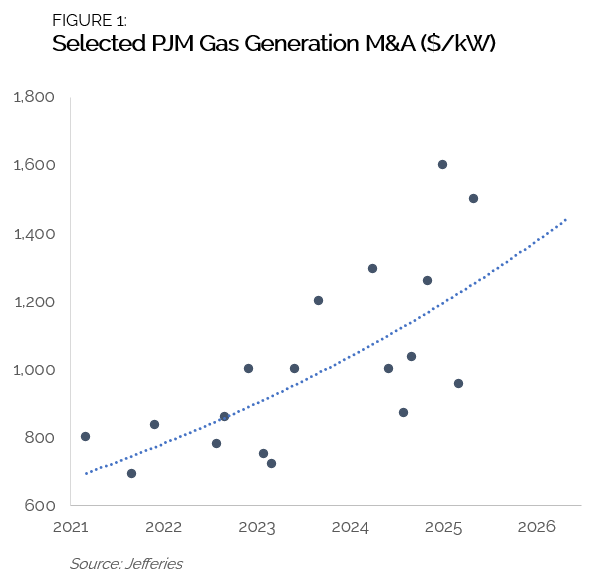
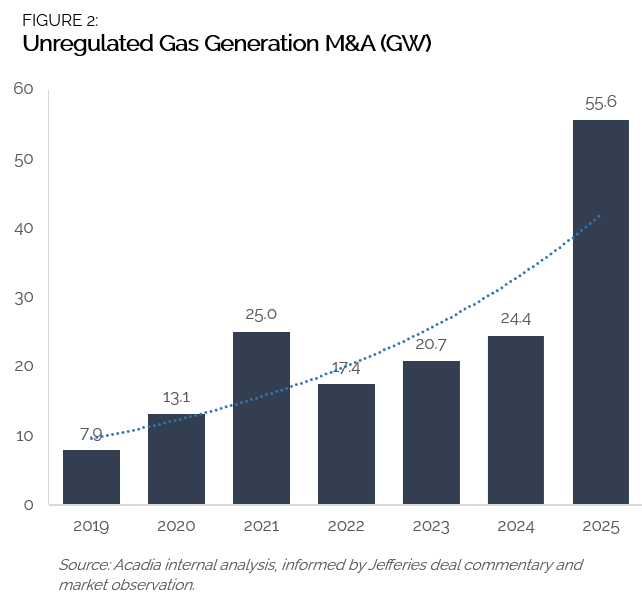
It is correct to make the general observation that many plants have transacted at higher values and implied valuations, on certain metrics (Figure 1), and deal volume has grown rapidly (Figure 2). Taken together, it’s not hard to understand why this question arises. However, there are a myriad of factors that have changed in favor of the asset class, and just as many new challenges and uncertainties. Here we explore these considerations through the lens of an operating PJM combined cycle gas turbine (CCGT).
Though our analysis is focused on a single asset type (CCGT) in a single market (PJM), it surfaces dynamics that we see playing out across a variety of asset types and markets. We explore each point in more detail, but can summarize them as follows:
Following decades of relatively low-to-flat growth, U.S. power demand is growing rapidly, but rising demand does not lift all boats. Gas turbines and other major equipment now carry multi-year lead times, meaning new plants cannot be built fast enough to address near-term demand.
The supply/demand imbalance has driven capacity prices sharply higher, drawing political intervention as affordability pressures run up against new demand that cannot be met. PJM is the clearest example, but market reform risk has increased across all U.S. power markets.
We caution that while underlying, unmet demand may be measured in hundreds of GW to 2030, this does not mean that load shows up on the grid. Alongside challenges with new generation are: transmission constraints; community opposition; county- or state-wide moratoriums; hotly debated new tariffs for large loads; and questions of cost allocation and affordability.We believe these factors will slow but extend load growth well into the next decade.
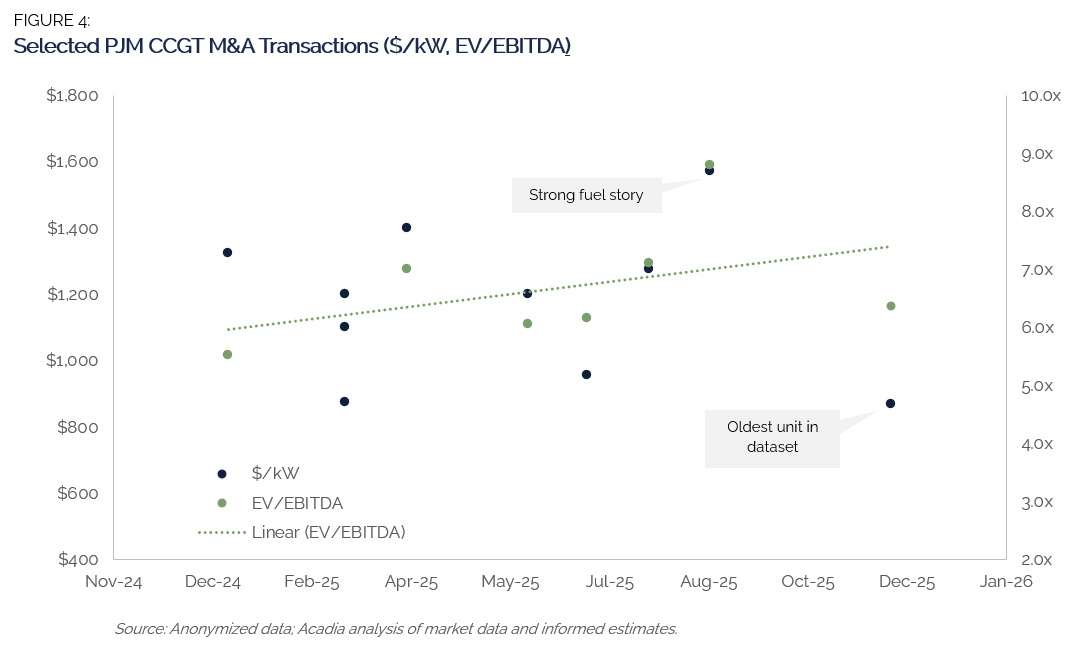
Valuations on a $/kW basis may dominate headlines, but this metric ignores the value of energy products sold by the assets, among many other factors. EV/EBITDA, not $/kW, provides a more grounded view of valuation.
Replacement cost is a poor valuation metric in this environment, because new-build CCGTs will only proceed with premium contracts, and current market clearing prices – e.g. PJM Base Residual Auction (“PJM BRA”) clearing prices – do not support new entry.
Scarcity is driving a new re-contracting dynamic. Utilities and large loads are now signing longer-term contracts for firm power. Contracts that roll off are today more of a worry for the load-serving entity than the asset owner.
Our view is that broad claims about gas plant overvaluation tend to miss important distinctions across markets, contract structures, and asset quality. In most cases, valuation depends less on a broad view of “gas” and more on the specific market, revenue construct, and operating profile of the asset. However, rapidly mounting bottlenecks are delaying new generation (and load) to such an extent that operating, firm generation assets – with permits, interconnection and equipment needs solved long ago – are likely to experience an extended period of scarcity value, as will the energy and capacity products they provide. We believe this scarcity value will be a dominant driver of value for longer, and note that improving existing infrastructure is typically faster and less challenging than building greenfield.
1 The underlying issues
1.1 Demand growth has a supply problem: We have entered a period of growth in power demand not seen in decades. Whether one believes 100% of the forecasts for new load from data centers, or 25% of it, this statement holds true. This growth is a sharp break from the ~1% p.a. growth rate the U.S. has experienced in the prior 30+ years, and critically, it’s about more than just demand for compute. We are of the view that constraints on power supply will materially slow realization of the massive underlying demand, adding significant durability to this thematic. Generally speaking, the period of low power pricing and low load growth – which has now moved far into the proverbial rear-view mirror – led to an underinvestment in (i) transmission; and (ii) new, dispatchable generation.
1.2 Supply chain and equipment cost: During the PJM CCGT buildout of the 2010s, gas turbines were available at reasonably low cost and on reasonably acceptable lead times. Today, a deposit placed tomorrow for a ‘slot’ in an OEM’s (think GE, Siemens, and Mitsubishi for CCGTs/CTs) order book, might bring the buyer a turbine in 2031. This would also mean the buyer / developer / IPP has advanced development to the point of confidence that the plant will be able to come online by then. Even advanced projects are requiring extensions (and in some cases, those are being denied). In recent years, early-stage gas plant development has been minimal, meaning most projects are still years away from being ready to place an order at all. We see similar trends in demand for large-scale, often customized main power transformers and switchgear.
1.3 Market reform, politics, and affordability: Energy costs for the consumer have ballooned recently. Putting inflation and other impacts aside, this has led to political pressure on energy and within that, electricity costs. You can think of this dynamic between politics, affordability, market pricing, and the solutions to supply as follows:
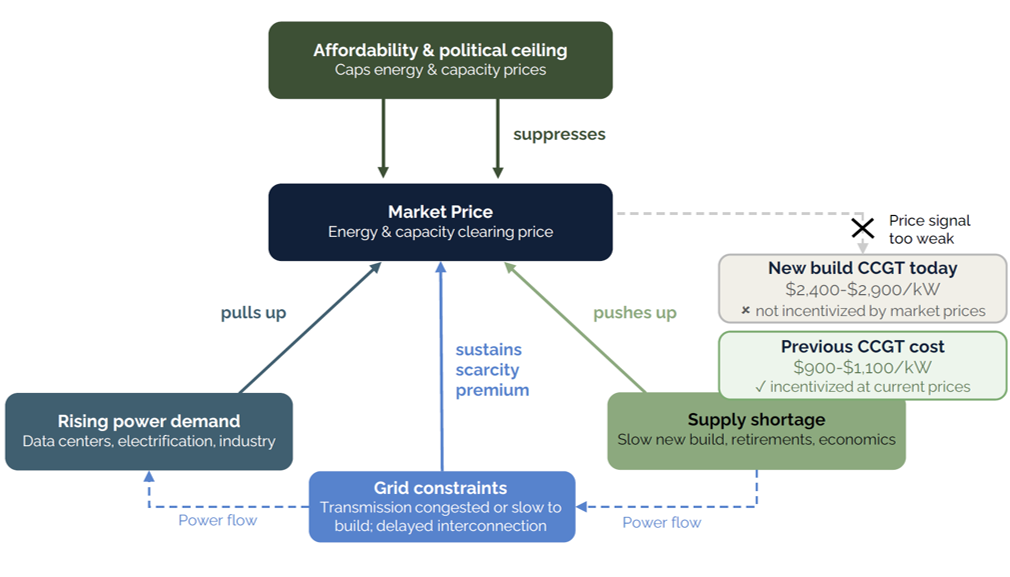
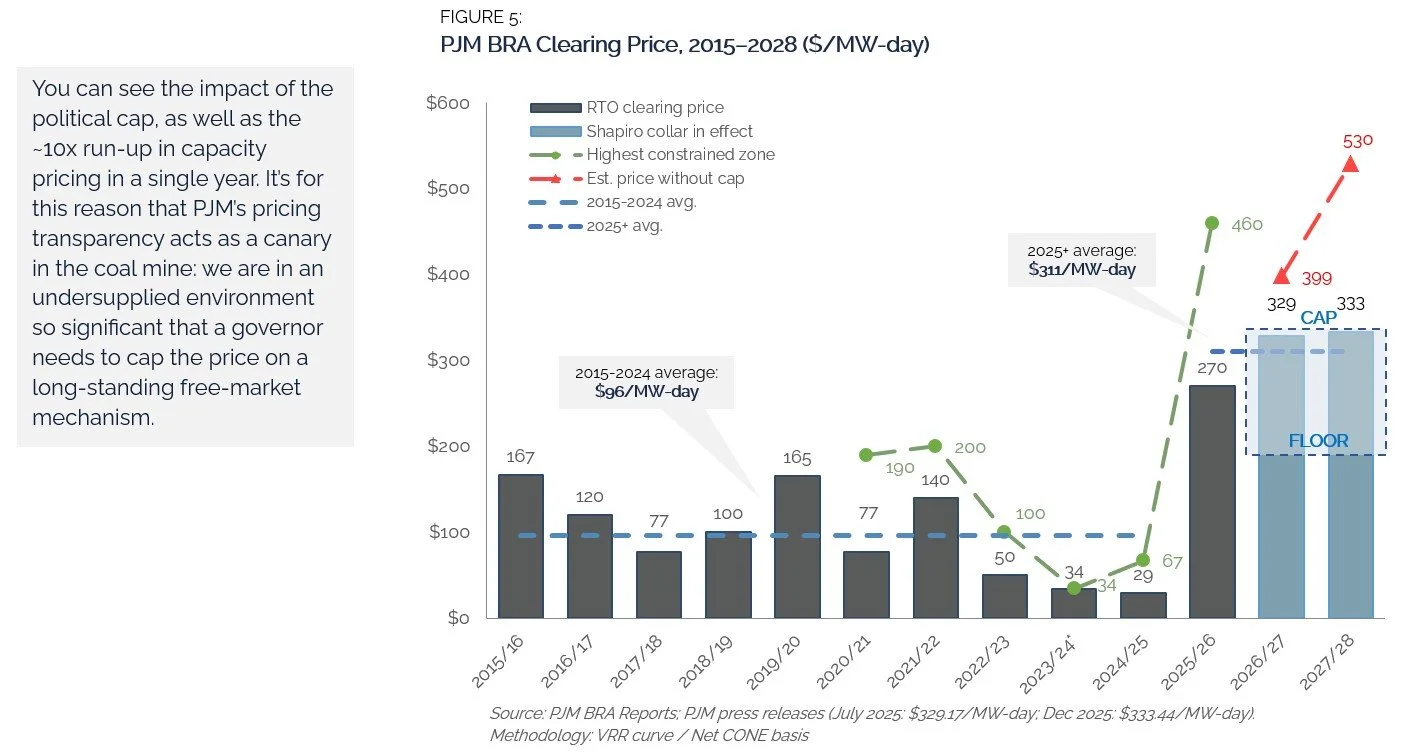
In PJM, for example, the cleared price jumped from about $29/MW-day for the 2024–25 delivery year to roughly $270/MW-day for 2025–26. Prices rising that quickly invite intervention: price caps, cost-allocation fights, and state-level measures aimed at shielding ratepayers. We are seeing this across utility dockets nationally. In PJM specifically, Pennsylvania Governor Josh Shapiro’s intervention led to both a ceiling and floor on capacity auction prices (the “Shapiro Collar”). That political cap, however, is in direct conflict with the price signal needed to incentivize new build generation. This is why new large loads (think: data centers) are being asked to ‘Bring Your Own Generation / Capacity.’ That is a topic for another day, however.
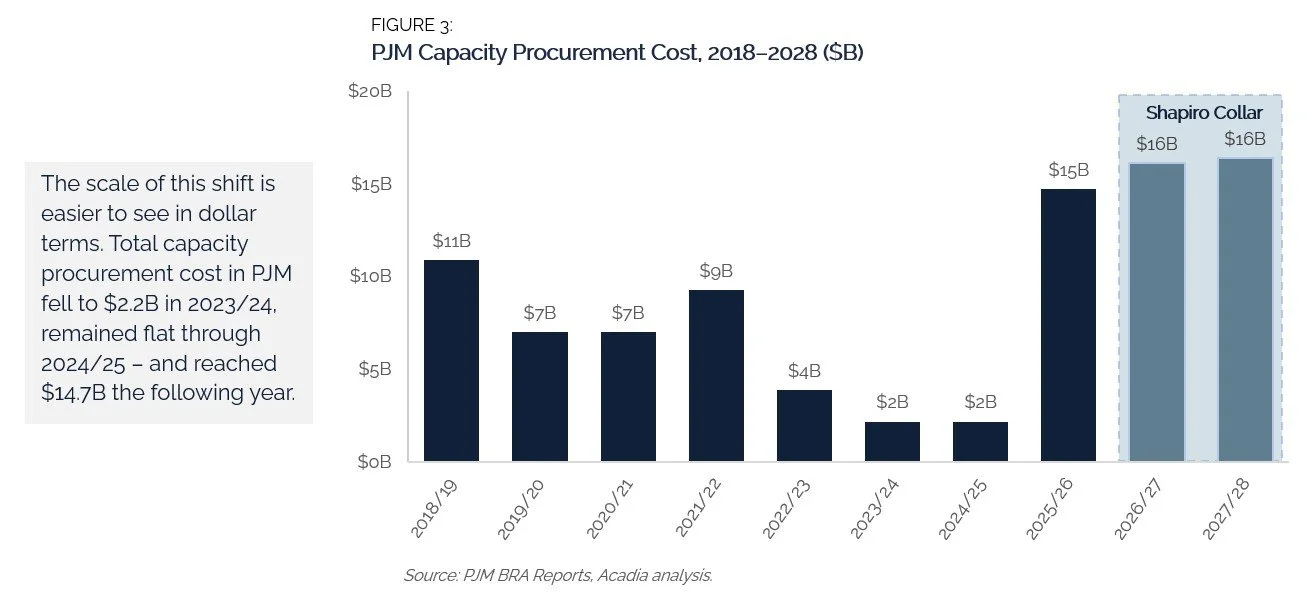
Affordability as an issue and public recognition of the drivers behind it put the spotlight firmly on PJM’s 2025/26 Base Residual Auction (BRA). The BRA is the mechanism through which PJM has procured capacity (as opposed to energy) since 2007. In turn, the 2025/26 PJM BRA put a spotlight on the significance of the supply shortfall we are facing – with ratepayers picking up the tab. This 2025/26 auction alone, which is just one component of consumer electricity bills, increased approximately 7x from the prior year, from ~$2B to ~$15B. All of this adds up to mean that we cannot simply ‘buy our way out’ of this situation.
2 Valuation
2.1 If you’re measuring valuation, look beyond $/kW
Most claims that “gas valuations are overheated” tend to be based upon $/kW. This is a commonly used metric but misses important factors. Key considerations should also include:
EV/EBITDA: Value is ultimately about cash flows - what is the forward EV/EBITDA? Is that driven by attractive top-line revenues, efficient equipment, or access to attractive gas supply?
Contracting: what is the plant’s contract tenor and offtake structure?
Power market liquidity: is the plant in a bilateral / vertically integrated market, or in an ISO?
Market: does the market compensate for capacity and energy (e.g. PJM, CAISO, ISO-NE) or just energy (e.g. ERCOT)?
Market reform: how much risk exists in ongoing market reform efforts? PJM and ISO-NE are among the most noteworthy, ongoing market reform processes at present.
Figure 1 (page 1) indicates why many are making this valuation observation. There is a genuine upward trend in valuations on a $/kW basis, perhaps in the +50% range, depending on how one measures it. However, looking at EV/EBITDA multiples (noting some are informed estimates) for more recent PJM CCGT transactions, we see an uplift closer to 25%. That ~25% uplift in valuation should be viewed in the context of scarcity value and market pricing: PJM BRA pricing for the 2025/26–2027/28 delivery years is more than 3x the 2015–2024 average (see Figure 5), while energy margins continue to expand. But that is a game of averages and misses critical, asset-level adjustments. Can we say $1,600/kW is too high? Maybe. But we can say with much more confidence that 9-10x EV/EBITDA is a strong multiple that needs a lot of asset-level differentiation, most of all in revenue contract opportunities, gas supply and asset quality factors such as turbine model, major maintenance costs and heat rate, to name a few.
However, as an investor, we would not pay the same price for an uncontracted (or unlikely contracted) plant in a market undergoing significant market reform, as opposed to a fully contracted plant at current market rates with a strong counterparty credit and a favorable contract structure (such as a toll). This alone can swing value by +/- $500-$1,000/kW. Hence – look beyond $/kW.
2.2 Replacement cost is not the right metric, either
It’s tempting to justify valuation with comparisons to replacement costs. If one uses the $/kW metric, on the surface it seems like a real value proposition: if replacement costs are ~$2,500/kW or higher for a new CCGT, why would one have an issue with $1,600/kW for an existing plant today? The answer here lies in the fact that new-build CCGTs are only moving ahead with a premium-priced contract in hand (>$15/kW-month). Because of the aforementioned political pressure, investors and developers do not think the market will compensate them in light of the tight supply-demand dynamics, and are therefore unwilling to build ‘on-spec.’ At current politically suppressed market prices, this new-build cannot be justified financially. It’s for this reason we’re seeing an uptick in long-term utility and corporate offtake in otherwise liquid power markets for the first time in decades.
This has led to an unexpected collision that is eroding our ability to meet underlying demand signals. Had the PJM market been allowed to run its course, capacity prices would have cleared at levels that would begin to compensate for new entry, illustrated by the red $399 and $530/MW-day values in Figure 5 below, making replacement cost a more relevant figure. But the political cap prevents this, and in doing so, breaks the ability of the market to operate efficiently. PJM is one clear example of the same trend we see playing out across the country: solving for affordability and new capacity at the same time is incredibly difficult.
2.3 The re-contracting environment has shifted materially
For a significant subset of operational, dispatchable generation, there is a scarcity premium (and therefore pricing confidence) to be enjoyed. Whereas buying a CCGT in PJM in 2019 would have felt more like buying ice in the Arctic, today it can be said that the fundamental value of these assets has risen materially because they are in short supply. The load-serving entities (LSEs) are in as much of a scramble as investors in a PJM asset auction to secure long-term, low-price volatility, reliable power supply. This represents a material market shift: utilities are now signing long-term contracts for both existing and new-build, firm, dispatchable power assets. In this category, CCGTs have demonstrated the strongest contracting demand among dispatchable thermal assets. As such, contracts that roll off are today more of a worry for the LSEs than the asset owners. That dynamic has meaningfully ‘flipped the script’ in operating gas M&A.
3 In conclusion, what’s the answer – are operating gas plants overvalued?
Our honest answer is, it depends – but the current market dynamics suggest the scarcity value of dispatchable generation will be an important part of the narrative into the 2030s, as the fleet of new capacity runs up against a multitude of challenges.
Some operational gas generation, particularly the most efficient new turbines, are in fiercely competitive auctions, clearing at transaction values that leave little room for downside, in our view. This appears more prevalent in PJM than elsewhere. Should such assets secure long-term contracts at current market rates, that could flip, however.
Rising demand does not lift all assets: in some markets (such as CAISO), gas is getting increasingly squeezed by BESS and hydro. In turn, gas assets relying heavily on energy margins are seeing value erosion unless they’re contractually protected. That is to say that no market is alike, just as no gas plant is alike, and no general conclusion can be drawn across the technological category.
We are still observing transactions in the middle market that represent, in our view, undervalued assets at the prices at which they are trading. We see fewer such opportunities at the upper end of the M&A market.
It’s clear that firm generation in premium markets is fundamentally more valuable in the current environment. However, with valuations at historically high levels, it has become increasingly critical for infrastructure investors to understand how those power markets function, how they can change, and how asset values move with location, all the way down to the node and the substation associated with it.
Sources
A note on scope:
PJM was selected for this analysis for several reasons: (i) it is the largest ISO in the US; (ii) it is home to the majority of US data centers; (iii) it has the longest-standing capacity auction; (iv) electricity prices played a key role in recent gubernatorial elections (NJ, VA); (v) it has a high degree of price transparency; and (vi) it is undergoing significant market reform that could materially change the economics of many plants.
American Society of Civil Engineers, "2025 Report Card for America's Infrastructure"
Bloomberg, "Pennsylvania to Michigan, High Electric Bills Infuriate Voters Ahead of Midterms" (Apr. 2026)
BloombergNEF, 2026 Sustainable Energy in America Factbook
Brookings, "How rising electric rates could affect the 2026 midterms" (Apr. 2026)
CAISO, 2024 Annual Report
Canary Media, "States are getting serious about energy affordability" (Jan. 2026)
Capacity, "New York just changed the rules for every data centre on earth" (June 29, 2026)
Capital Power, press release (Apr. 14, 2025)
Clean Air Task Force, "2025 Wins and Emerging Trends in State Climate Policy" (Jan. 2026)
Congressional Research Service, R48553 (June 2025)
E&E News
"In pivotal move, PJM puts new power market designs on the table" (May 7, 2026)
"Electricity rates a potent political issue ahead of 2026 midterms" (Dec. 23, 2025)
Enverus Intelligence Research, "At the cap, below CONE: Why PJM's capacity market needs a reset" (June 17, 2026)
FERC, Order (Apr. 21, 2025)
GE Vernova, Q1 2026 earnings call
Grid Strategies LLC and The Brattle Group, "Unlocking America's Energy: How to Efficiently Connect New Generation to the Grid" (Aug. 2024)
GridLab, "Acquisition Costs for Existing Gas Power Plants are Rising" (Sept. 2025)
Indiana Michigan Power (AEP), IURC filing for CPCN to acquire the Oregon Clean Energy Center (filed April 2025; approved November 19, 2025)
Lawrence Berkeley National Laboratory, "Queued Up: 2026 Edition" (June 2026)
Monitoring Analytics, 2025 State of the Market
NERC "2025 Long-Term Reliability Assessment" (Jan. 2026)
NextEra Energy, CEO John Ketchum (Gas Outlook, Mar. 2025)
NRG Energy, Q3 2025 earnings release (Oct. 2025)
PJM
2025/2026 Base Residual Auction Report (July 2024)
Base Residual Auction Reports (2018–2028)
Capacity Market Fact Sheet
Press releases (July 2025: $329.17/MW-day; Dec. 2025: $333.44/MW-day)
"Powering Reliability Through Market Design" white paper (May 6, 2026)
Project Finance & Development, "The Shift Back to Gas" (Aug. 2025)
Talen Energy Corp.
Form 8-K (Jan. 15, 2026)
Q4 2025 earnings
U.S. Department of Energy (DOE) Office of Policy, “Queued Up… But in Need of Transmission”
U.S. Energy Information Administration
AEO2026 and January 2026 Short-Term Energy Outlook (STEO)
Electricity Monthly Update (data through April 2026)
Today in Energy (May 14, 2025), (Nov. 2025), (Dec. 8, 2025)
Utility Dive
“GE Vernova gas turbine backlog hits 100 GW as prices rise” (April 23, 2026)
"New Jersey lawmakers send data center tariff bill to governor" (July 1, 2026)
"PJM opposes waiver for $2B gas-fired plant in fast-track interconnection review" (June 29, 2026)
Vistra Corp., press release (Jan. 5, 2026) — Cogentrix acquisition
Wood Mackenzie, Q2 2025
Disclaimer
Information presented is for informational purposes only and does not intend to make an offer or solicitation for the sale or purchase of any securities. This article and any associated links offer news, commentary, and generalized research, not personalized investment advice. Nothing in this article should be interpreted to state or imply that past performance is an indication of future performance. All investments involve risk and unless otherwise stated, are not guaranteed. Be sure to consult with a tax professional before implementing any investment strategy. Acadia is an investment adviser registered with the U.S. Securities & Exchange Commission. Registration does not imply a certain level of skill or training. Past performance is not indicative of future results.
This article does not purport to be complete on any topic addressed. The information in the article is provided to you as of the dates indicated and Acadia does not intend to update the information after its distribution, even in the event that the information becomes materially inaccurate. Certain information contained in the article includes calculations or figures which have been prepared by Acadia and have not been audited or verified by a third party. In addition, some information is provided by third party sources and although believed to be reliable, has not been independently verified. Use of different methods for preparing, calculating or presenting information may lead to different results and such differences may be material.